Life’s Origins in Space: A Collective Action Story | Green Donor
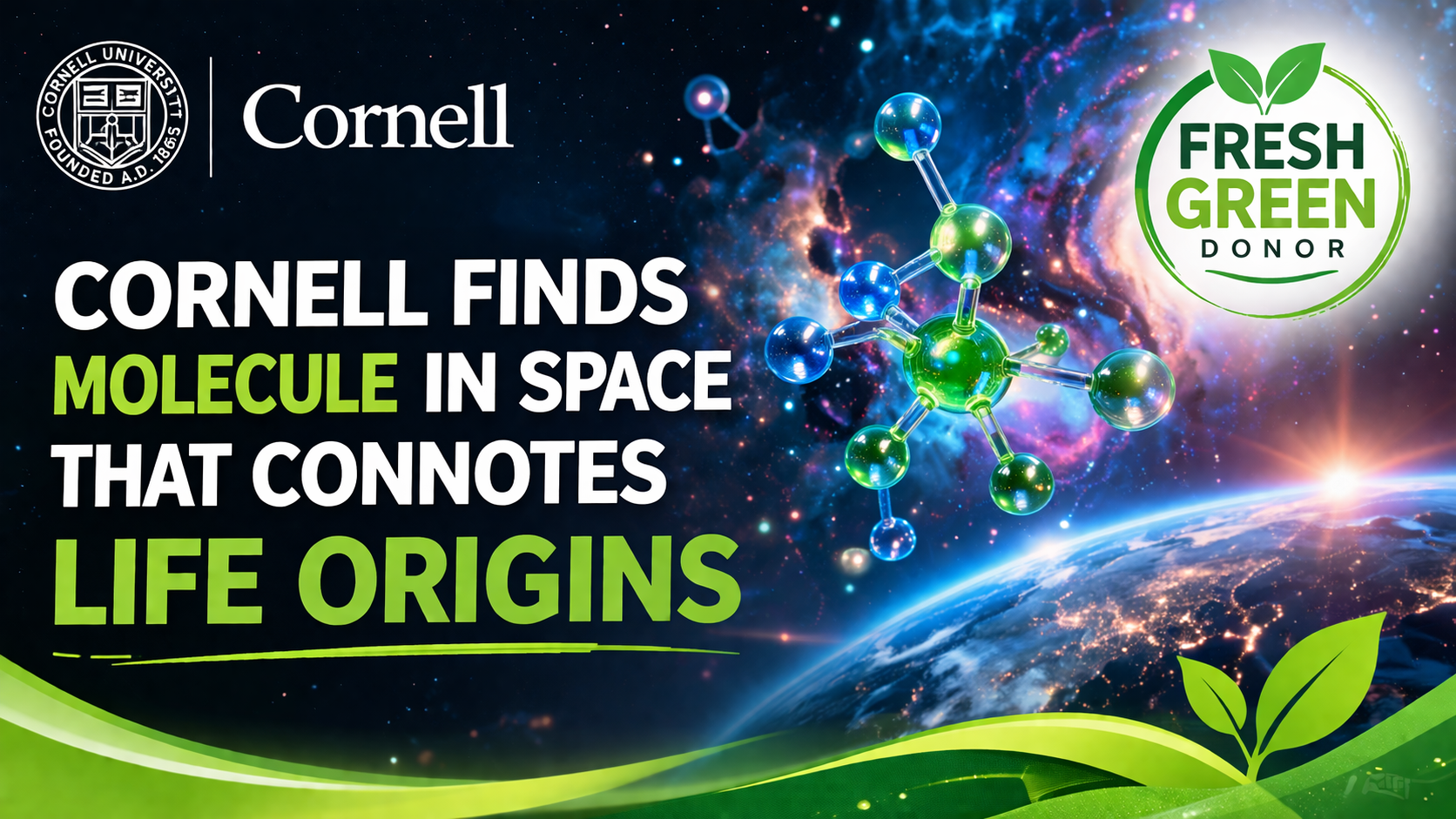
A recent scientific discovery has revealed a complex organic molecule in deep space—reshaping how we understand the origins of life. Beyond its scientific importance, this finding carries a deeper message: life is not created in isolation—it emerges through collective processes across the universe.
🌌 A Discovery Beyond Earth
Astronomers have identified isopropyl cyanide, a branched carbon molecule, within a distant star-forming region of our galaxy. This structure is significant because it resembles the complexity seen in amino acids—the fundamental building blocks of life.
What makes this discovery remarkable is its location. Found far beyond Earth, it suggests that the ingredients necessary for life are not unique to our planet, but are formed naturally in space.
🔬 The Universe as a Collaborative System
The cosmos operates through interconnected processes:
- Stars generate essential elements
- Interstellar clouds assemble complex molecules
- Cosmic bodies transport these materials across space
- Planets provide environments where life can develop
This reflects collective action at a universal scale, where each component plays a role in a much larger system.
🌱 Earth’s Place in the Collective Chain
On Earth, the same principle continues. Ecosystems function through interdependence—soil, water, air, plants, animals, and human communities all contribute to balance and survival.
This aligns with the Green Donor philosophy:
- Sustainability depends on shared responsibility
- Environmental protection requires collective participation
- Small actions, when combined, create meaningful change
🌍 A Shared Responsibility for the Future
If life itself is shaped by collective processes, then safeguarding it must also be a collective effort.
Global challenges such as climate change, pollution, and biodiversity loss demand:
- Community-driven solutions
- Collaborative innovation
- Long-term commitment from all sections of society
The lesson is simple: progress happens when systems work together, not in isolation.
🌿 Conclusion
The discovery of complex molecules in space is more than a scientific milestone—it is a reminder of how deeply connected everything is.
From the formation of stars to the growth of ecosystems on Earth, one idea remains constant:
This is a collective action, with a collective responsibility.
Our future, like our origins, depends on how well we act together.