The Six Maxims of Green Donor
The Six Maxims of Green Donor: Love, Service and Inner Peace
Love for Mother Nature, Integrity in Daily Life, and the Practice of Service
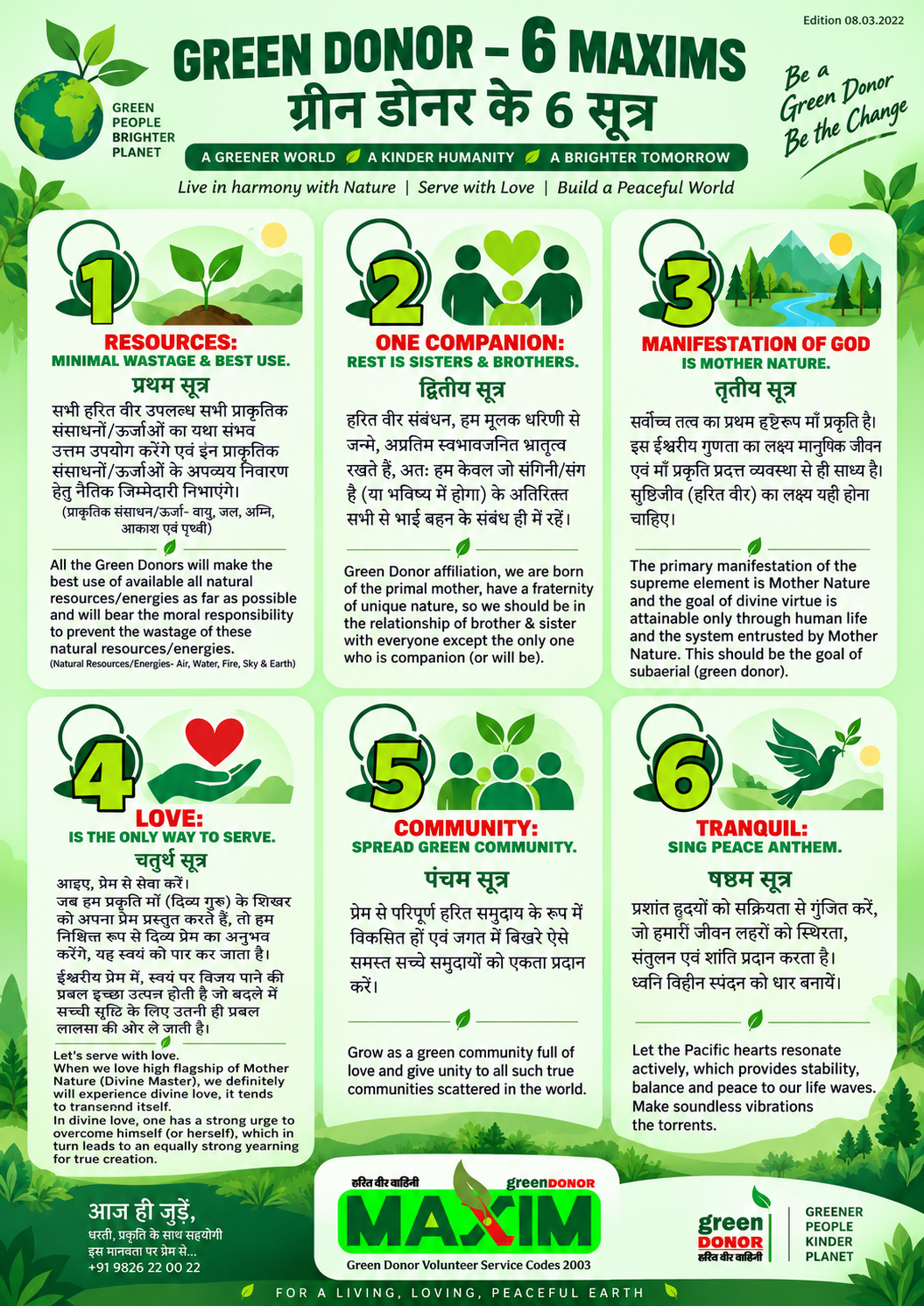
The six maxims of Green Donor are more than guidelines for environmental protection. They bring together our relationship with nature, our use of resources, our conduct towards others, our spiritual outlook, loving service, and community life. Their purpose is to cultivate a way of living in which reverence for nature is reflected not merely in our thoughts, but also in our decisions and actions.
Practising these maxims does not mean claiming perfection. It means making a sincere effort to become a little more mindful, responsible, and loving each day.
First Maxim: Minimal Wastage and the Best Use of Resources
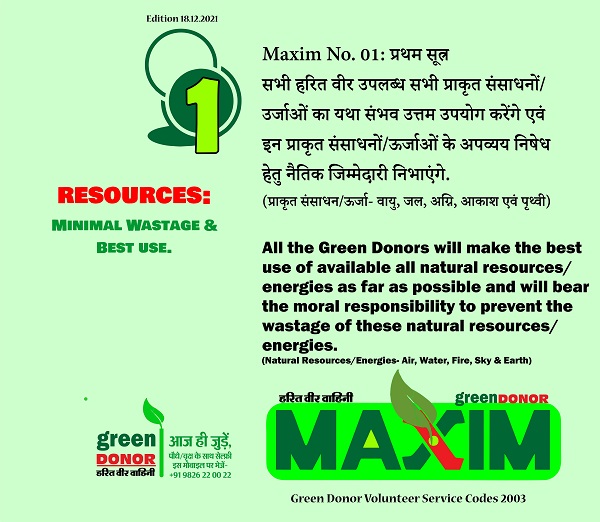
Core meaning: Make the best possible use of available natural resources and energy, and accept the moral responsibility to prevent their wastage.
This maxim teaches us to consume thoughtfully. The availability of a resource does not justify using it unnecessarily. Our treatment of water, food, fuel, and other useful materials reveals how much we respect what we receive from nature.
Two principles are equally important here: minimising waste and making good use of what is available. Conservation does not mean merely keeping things unused; resources should also serve meaningful purposes when needed. Sharing an unused but useful item with someone who needs it is one example of putting resources to better use.
The maxim’s reference to air, water, fire, sky, and earth expresses a comprehensive sense of responsibility towards nature through the traditional perspective of the five elements.
In everyday life, this means taking only what we need, avoiding food waste, not consuming water or electricity unnecessarily, caring for our possessions, and choosing repair and reuse wherever appropriate. Paying the financial cost of a resource does not bring our moral responsibility towards it to an end.
The practice of this maxim is to honour everything received from nature through responsible use.
Second Maxim: Faithfulness to One’s Life Partner and a Spirit of Kinship with All Others
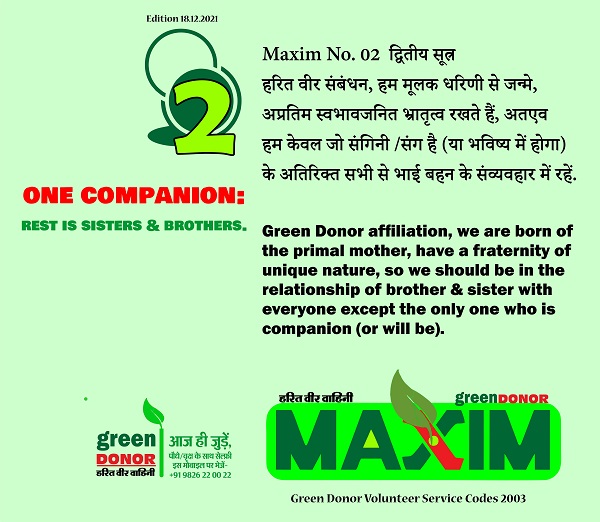
Core meaning: Recognising our shared connection to Mother Earth, remain faithful to your life partner and treat the wider human family with the respect and care you would extend to brothers and sisters.
This maxim brings warmth and appropriate boundaries into our relationships. Our shared connection to Mother Nature encourages us to see others not as strangers, but as members of a larger human family.
It also recognises the distinct nature of the relationship between life partners—a relationship that calls for faithfulness, trust, and responsibility. Treating others as brothers and sisters means respecting their dignity and keeping our relationships free from selfishness, deception, exploitation, and possessiveness.
The practical meaning of this principle goes beyond simply addressing someone as “brother” or “sister.” The more important questions are: Does our behaviour show respect? Do we honour another person’s wishes and personal boundaries? Do we consider their well-being rather than take advantage of their vulnerability?
This maxim does not narrow the scope of love. It encourages a wider sense of belonging while honouring the distinctive nature and dignity of each relationship.
The practice of this maxim is faithfulness in one’s partnership and respect for all humanity.
Third Maxim: Recognising Mother Nature as a Manifestation of the Supreme
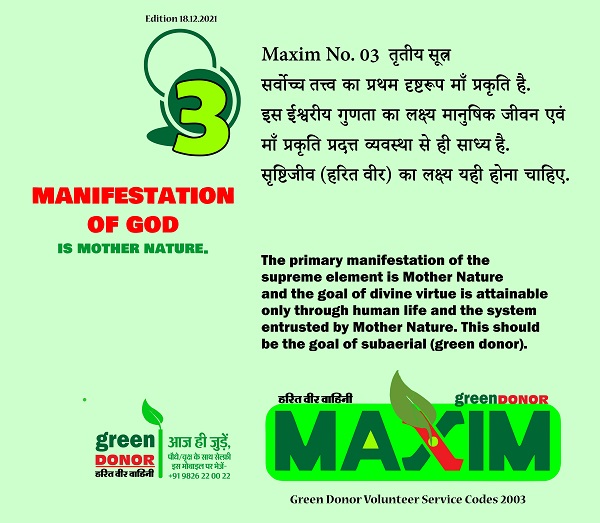
Core meaning: Within Green Donor’s spiritual outlook, Mother Nature is understood as a visible manifestation of the Supreme. Human life, within the order provided by nature, is the setting in which divine qualities are to be cultivated.
This maxim offers a spiritual way of looking at nature. Mother Nature is not regarded merely as a resource to be used or an environment outside us, but as a foundation for reverence and a deeply felt relationship. From this perspective, respect for nature is inseparable from spiritual life.
Its meaning is not that spirituality must be sought by withdrawing from the world. Rather, it is to be cultivated through the way we live and behave. Qualities such as love, compassion, truthfulness, purity, and responsibility become meaningful when they are expressed in our conduct towards people and other living beings.
A practitioner who perceives the divine in Mother Nature may ask: How do I treat that which I hold sacred? Are my habits consistent with my reverence? Is my spirituality making me more sensitive and responsible?
From this perspective, caring for a plant, respecting water, or showing compassion towards a living being becomes more than an outward activity. Each is an opportunity to translate reverence into action.
The practice of this maxim is to express reverence for Mother Nature through one’s character and actions.
Fourth Maxim: Love Is the Only Way to Serve
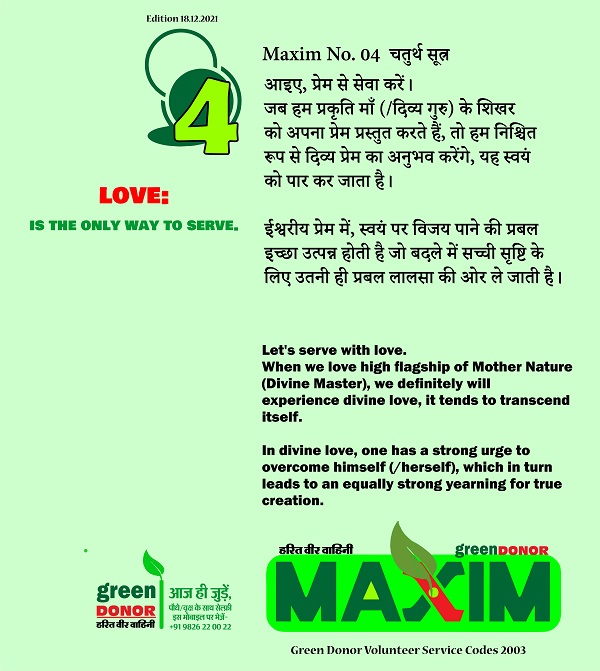
Core meaning: Serve with love, and allow devotion to Mother Nature to become an opportunity to rise above narrow self-interest and refine your inner life.
This maxim draws attention to the intention behind service. Performing a task and performing it with love are not the same. Loving service considers the needs, dignity, and well-being of those being served. The expectation of praise, control, or personal advantage does not occupy its centre.
The maxim includes the spiritual understanding of Mother Nature as a Divine Master. Within this outlook, love and devotion encourage the practitioner to move beyond the ego. Service becomes not only a means of bringing about change outside oneself, but also an opportunity to recognise selfishness, impatience, and the desire for recognition within.
Here, overcoming oneself does not mean suppressing oneself or becoming harsh towards oneself. It means learning to regulate the tendencies that obstruct loving and responsible conduct. Giving greater attention to a sapling’s continued care than to a photograph of its planting, or helping someone without making them feel inferior, are simple examples of this spirit.
Love prevents service from becoming merely an isolated event. It turns service into an ongoing relationship of care and responsibility.
The practice of this maxim is to place the well-being of those being served—not one’s own importance—at the centre of service.
Fifth Maxim: Nurturing a Loving Green Community and Bringing Communities Together
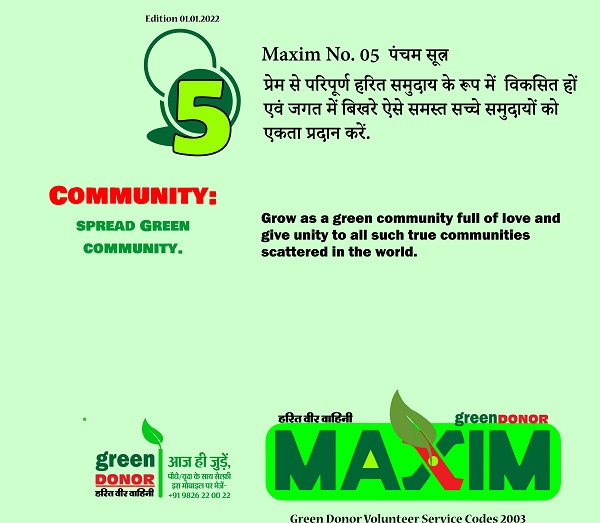
Core meaning: Grow as a green community filled with love, and bring together communities across the world that work with a similar spirit of goodwill, unity, and cooperation.
This maxim connects individual practice with collective responsibility. Love for nature should not remain confined to one’s personal life; it should become a foundation for participation within families, neighbourhoods, educational institutions, and the wider community.
A green community is more than a group of people sharing a name, identity, or membership. Its real foundation is responsibility towards nature, mutual respect, love, and a willingness to work together. Community becomes a lived reality when people learn from one another, share the work, and take responsibility for a common purpose.
Another important aspect of this maxim is connecting well-intentioned communities working in different places. This does not mean erasing their identities or making everyone alike. It means respecting their diversity while cooperating towards a shared purpose.
In practice, this may involve joining a local water-conservation effort, sharing responsibility for the care of plants, exchanging useful experiences, or supporting another group’s constructive work. Participation should be voluntary, not driven by pressure.
The practice of this maxim is to transform love for nature into a culture of shared responsibility and cooperation.
Sixth Maxim: A Tranquil Heart, a Balanced Life, and the Peace Anthem
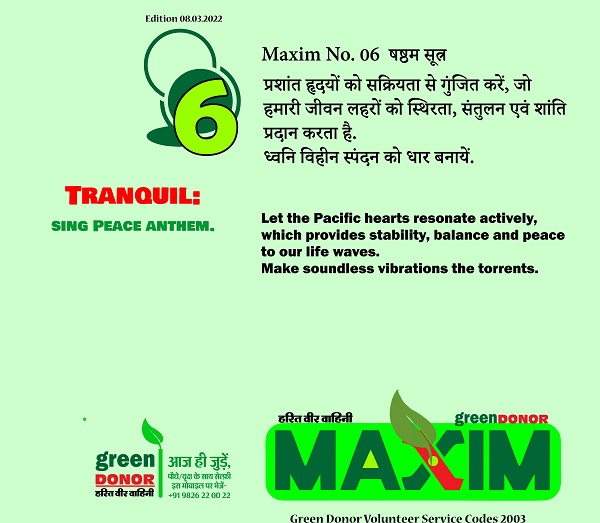
Core meaning: Keep peace alive within the heart and allow it to flow into life through the Peace Anthem, thought, and conduct.
This maxim draws attention to the inner atmosphere of our practice. Even while serving, impatience, competition, or bitterness may arise. Being active is therefore not enough; we must also remain attentive to our feelings and reactions.
Peace does not mean passivity. A peaceful person can speak clearly, make necessary decisions, and act firmly to prevent harm to nature. The difference lies in whether that action is guided by discernment and responsibility rather than hostility or uncontrolled emotion.
The Peace Anthem gives collective expression to inner peace. The phrase “let soundless vibrations become a flowing stream” may be understood as a spiritual metaphor: peace should not remain confined to the words we sing. It should be quietly present in our character and conduct, even without announcement.
Listening attentively, pausing before reacting, avoiding insulting language during disagreements, and seeking cooperation even in difficult circumstances are practical expressions of this maxim.
The practice of this maxim is not merely to sing of peace, but to live with tranquillity and balance.
The Six Maxims as One Way of Life
The first maxim brings responsibility to our consumption. The second brings faithfulness and respect to our relationships. The third gives spiritual depth to our relationship with nature. The fourth brings love into service. The fifth connects individual effort with community cooperation. The sixth provides inner peace and balance throughout the practice.
Within the Harit Veer Vahini Sadhana Chakra, these six maxims form the foundation of daily conduct. Prayer strengthens the resolve to practise them, self-study deepens their meaning, and practical green service translates them into action. Their practice is an opportunity to examine our own lives before judging others.
Responsibility towards nature, integrity in relationships, spirituality in outlook, love in service, unity in community, and peace within the heart—together, these express the integrated philosophy of Green Donor’s six maxims.
Six Maxims of Green Donor, Green Donor philosophy, Harit Veer Vahini, love for Mother Nature, nature-conscious living, spiritual growth through service
The Green Donor Six Maxims connect responsible resource use, respectful relationships, reverence for Mother Nature, loving service, community cooperation and inner peace. Discover their meaning and how to put them into practice through mindful choices and everyday actions.
#GreenDonor #SixMaxims #HaritVeerVahini #MotherNature #EcoSpirituality #LovingService #GreenCommunity #InnerPeace