From Consumer to Donor: Sustainable Living | Green Donor
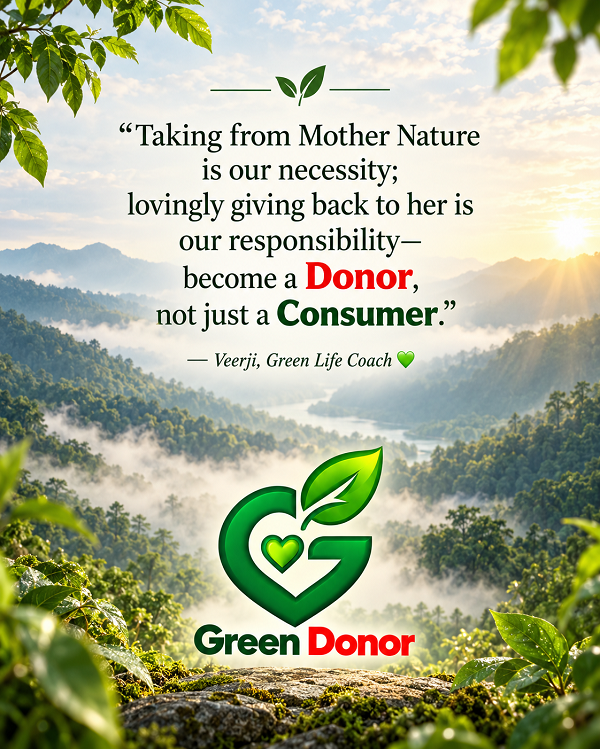
From Consumer to Donor
A Way of Living That Gives Back to Mother Nature
— Veerji, Green Life Coach 💚
Discover how gratitude, responsible consumption, and everyday service can turn our relationship with nature into a lifelong commitment.
Moving from consumer to donor means learning to give back to the life that sustains us. Through responsible consumption, sustained tree care, and everyday acts of service, we can turn gratitude towards Mother Nature into meaningful action. This is the invitation at the heart of Green Donor: fulfil our needs with awareness, recognise our shared responsibilities, and contribute our time, skills, and care to the living world.
Every day, we receive something from life: air to breathe, water to drink, food to nourish us, space to inhabit, and opportunities to grow. Our achievements involve our effort, certainly, but their foundations extend beyond anything we have earned. They include nature’s nourishment, society’s cooperation, and the contributions of countless unseen hands.
Yet when we take stock of our lives, we usually ask: How much have I gained? What have I earned? What do I own?
Less often do we pause to ask: What has life received because I am here?
The journey from consumer to donor begins with this question.
It is not merely an invitation to contribute money. It is an invitation to move beyond receiving towards responsibility, beyond accumulation towards participation. It asks us to recognise what sustains us, bring discernment to our needs, and place some part of our time and ability in the service of the living world.
Consumption Is Necessary; Consumerism Is Not
We cannot live without consuming. Food, clothing, shelter, education, healthcare, and useful conveniences are genuine needs. Becoming a donor does not mean rejecting modern life, abandoning progress, or presenting deprivation as a spiritual achievement.
The difficulty begins when the distinction between need and accumulation disappears. We replace a useful possession simply because a newer version exists. We judge a celebration by its expense rather than its joy. We measure our worth by our ability to purchase more than someone else.
At that point, possessions no longer merely serve our lives; they begin to govern our identity.
Before buying, let us pause. Is this genuinely necessary? Could the existing item be repaired? Could something be shared? Could the same need be met with fewer resources?
This approach is consistent with the United Nations’ Sustainable Development Goal 12, which promotes responsible consumption and production, efficient resource use, and waste prevention. Sustainable Development Goals
Restraint need not diminish enjoyment. It can mean refusing to make enjoyment dependent on endless acquisition.
The question is not whether we are allowed to enjoy what we have. The question is whether our enjoyment requires us to remain dissatisfied, continually replacing what still serves us and overlooking the cost of that habit.
A Pressured Planet—and Unequal Responsibilities
This reflection is not only a moral appeal. The Global Resources Outlook 2024, produced by the UNEP-hosted International Resource Panel, reported that global extraction of natural resources had tripled over the preceding five decades. It connected resource extraction and processing with substantial climate, biodiversity, and pollution impacts. UNEP – UN Environment Programme
However, responsibility cannot be distributed as though everyone consumes equally. The report also highlighted that people in high-income countries use approximately six times as many resources per person as those in low-income countries. UNEP – UN Environment Programme
Environmental responsibility must therefore include fairness. Greater consumption and greater capacity should carry greater responsibility.
Before asking a family without sufficient food or secure shelter to practise sacrifice, we must recognise its right to a dignified life. Donor consciousness does not begin by making another person’s plate smaller. It begins by questioning our own unnecessary excess.
We should seek prosperity that provides comfort without glorifying waste, and development whose benefits do not remain confined to a privileged few.
Mother Nature Is a Relationship, Not a Possession
Calling nature Maa Prakruti—Mother Nature—should mean more than choosing a beautiful expression. The truth of that relationship must become visible in our conduct.
Do we respect the water we describe as life-giving? Does our affection for trees extend to understanding their needs? Does our gratitude influence decisions when convenience pulls us in another direction?
To call nature our own is not to claim ownership over her. It is to acknowledge that we cannot live as though we have no relationship with her.
Veer, one who serves the Mother does not imagine himself her master. He learns, observes, and allows understanding to correct his preferences.
Even giving requires humility. We do not become greater than nature by offering something back. The strength, time, and resources we contribute also arise within the life she sustains.
Giving back is therefore not a declaration of superiority. It is gratitude becoming responsible action.
Within this understanding, wealth must include more than possessions. It should also include the care we offer and the responsibilities we honour.
Giving Is Larger Than Money
One does not need to be wealthy to become a donor. Someone can offer time, another knowledge, another practical skills, and another the patience to organise a shared effort.
A person may help care for trees, explain environmental ideas to children, maintain a community project’s records, or teach fellow volunteers how to perform a task responsibly. These are invitations to participate, not tests of financial capacity.
However, giving must also be useful. Passing unwanted possessions to someone who does not need them may simply transfer our burden. Genuine service requires a conversation between what we wish to offer and what is actually needed.
Ask: What would help here? Which responsibility can I reliably fulfil? How will the work continue when I am absent?
A donor is not necessarily the person whose generosity receives the loudest announcement. A donor may be the quiet presence that makes essential work dependable.
The dignity of the person receiving support should remain as important as the intention of the person offering it.
We should also promise within our capacity. A modest commitment fulfilled regularly is more honest than an impressive pledge repeatedly abandoned. Service should be built around real availability, shared responsibility, and the willingness to communicate when help is needed.
When Spirituality Becomes Everyday Conduct
To confine spirituality to private peace is to leave its practical meaning unfinished. Alongside asking how deeply we experience silence, we can ask how thoughtfully we behave towards the life around us.
Sadho, the belonging we experience with closed eyes should remain alive when we open them.
When we bow to Mother Nature in prayer, let attentiveness to waste become part of that reverence. When we speak of compassion, let us make room for someone else’s needs. When we celebrate interconnectedness, let us accept the responsibilities that relationship brings.
Feeling love is beautiful. Giving that love time, effort, and continuity allows it to become service.
A simple daily question can guide this practice: What did I do today to care for a life, a relationship, or a shared resource?
The answer need not be grand. Completing an unfinished task, caring for a shared space, or helping another person learn can be a meaningful beginning.
Let gratitude become a decision, and let that decision find a place in our everyday habits.
In this way, prayer and practical action need not compete. One can deepen our intention; the other can reveal where that intention still needs work. The inner journey and the outward responsibility can illuminate each other.
Green Donor: From Feeling to Sustained Service
Green Donor, an initiative of The Eco-Earth Institute and Research Centre, EERC India, describes its work through environmental awareness, education, community participation, and practical conservation. This combination invites us to connect learning with action. Green Donor
GD Commons, or Green Donor Living Tree Commons, gives particular attention to the relationship that continues after planting. Its public process describes a 365-day tree-care journey, beginning with the tree’s details, planting location, and initial photograph, followed by a monthly photograph and a brief care update. Green Donor Living Tree Commons
The lesson is straightforward: Planting is an occasion; protection is an ongoing relationship.
Yet a photograph cannot replace care. A record should remind us of responsibility, not become a substitute for it. When a tree is struggling, understanding the problem matters more than producing a beautiful image.
Nor should completing a year mean that our responsibility has expired. A programme can establish discipline; the relationship with a living tree should extend beyond a certificate.
Let us ask not only how many trees we planted, but how faithfully we remained beside them.
Begin with the Kitchen, the Market, and the Home
Daily life offers a practical place to begin. Plan meals, buy thoughtfully, and pay attention to portions.
UNEP’s Food Waste Index Report 2024 estimated that 1.05 billion tonnes of food waste were generated in 2022 across households, food services, and retail. This total included inedible parts, and households accounted for approximately 60 per cent. UNEP – UN Environment Programme
These figures invite attention to avoidable waste, not indiscriminate blame.
A family could begin by observing what is discarded over a week and why. Then adjust purchasing, preparation, and serving accordingly. The purpose is to understand the pattern, not to find someone to accuse.
Apply similar attention to possessions. Keep useful things in service longer, repair them where practical, and reconsider purchases that answer no real need. UNEP’s resource recommendations also include reduction, reuse, repair, and recycling. UNEP – UN Environment Programme
Not every responsible action needs public recognition. The discipline practised quietly at home belongs to environmental service too.
Let Love for Greenery Be Guided by Understanding
Enthusiasm is valuable, but it should not replace knowledge. Planting trees on every apparently empty piece of land is not automatically the right ecological response.
The Food and Agriculture Organization explains that forest and landscape restoration goes beyond maximising tree cover. It involves restoring ecological functions while considering other land uses and the needs of local communities. FAOHome
Before planting, therefore, clarify the location, species suitability, local conditions, necessary permissions, and arrangements for continuing care. Seek guidance from people who understand the site. Setting an event date is not the same as completing the preparation.
Those without land need not consider themselves excluded. Explore agreed roles in an existing project: maintenance, coordination, record-keeping, or practical support. Pay attention to trees already growing, rather than assuming that service must always begin with planting another.
To walk with Mother Nature is to remain willing to learn from the place we are trying to serve.
Personal Commitment Must Meet Collective Responsibility
Environmental crises will not be resolved through individual habits alone. The United Nations’ 2025 review of Goal 12 emphasised the need for coordinated changes across policies, markets, systems, and behaviour, involving governments, businesses, civil society, and consumers. UNSD
Donor consciousness should therefore include civic responsibility. Improve personal practices while also supporting dependable waste management, accessible public transport, responsible production, and well-maintained shared green spaces.
A company’s donation should not be treated as permission to continue harmful conduct. Nor should a public institution use citizens’ voluntary service as an excuse to neglect its own duties. Contribution and everyday responsibility should reinforce, rather than contradict, each other.
Within a family or community, begin with a manageable task. Clarify its purpose, agree on responsibilities, and review what is actually happening.
Before announcing success, examine the results. Did the work meet a genuine need? Was the responsibility sustained? What needs to change?
Service becomes more trustworthy when enthusiasm is willing to learn from evidence.
Beyond Receiving: The Commitment to Give Back
Becoming a donor is not a one-day achievement. Old habits may return. Convenience may tempt us. Service may sometimes feel difficult.
When that happens, the task is not to construct an image of perfection. It is to return honestly to our commitment.
At the end of life, perhaps the most meaningful question will not be how much we possessed. It may also be what we helped preserve, whom we supported, and what we left available for those who would come after us.
Let us be more than recipients of Mother Nature’s gifts. Let us become dependable participants in her care.
Meet your needs, but leave room for another’s needs. Improve your life, but not through indifference to the life you share. Offer what you can, learn what you must, and honour what you undertake.
From consumer to donor: because the beauty of life lies not only in what we receive, but also in the responsibility we fulfil with love.
🌱 “Greenery every day, green inspiration every day—this is the spirit of Green Donor.”
Prakruti Pranam!
sustainable living, responsible consumption, giving back to nature, environmental responsibility, community tree care, spirituality in action
Green Donor, Veerji Green Life Coach, GD Commons, EERC India
Becoming a donor is about more than giving money. It is a way of living that transforms gratitude into responsibility. In this reflection, Veerji, Green Life Coach, explores how mindful consumption, practical service, sustained tree care, and spiritual awareness can help us give back to Mother Nature. Discover the Green Donor invitation to move beyond accumulation and make care for the living world part of everyday life.
From Consumer to Donor: Give Back to Mother Nature
What has life received because you are here? Explore Veerji’s invitation to live thoughtfully, care for nature, and turn gratitude into everyday service.