The Green Donor Effect and Greenhouse Effect Explained: Natural vs Artificial, Solutions & Sustainability
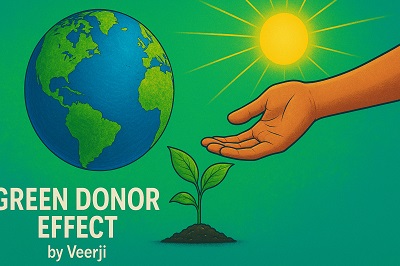
The Green Donor Effect and the Greenhouse Effect: Balancing Humanity and Nature
Abstract
This paper explores the intersection of the Green Donor Effect, a philosophy developed by Dr. SD Virendra (Veerji Sahib), and the scientific concepts of the natural and artificial greenhouse effects. The Green Donor Effect emphasizes reciprocal giving to nature, aligning human activities with ecological balance. This framework is analyzed alongside climate science, distinguishing between the natural greenhouse effect, which sustains life, and the artificial greenhouse effect, which accelerates climate change due to human actions. Drawing from ecological research, behavioral studies, and institutional examples, this study argues for a holistic approach to mitigating climate change that integrates spirituality, cultural responsibility, and scientific solutions.
Introduction
In the face of accelerating climate change, the concept of balance between human activity and nature has never been more urgent. Enter the Green Donor Effect, a philosophy crafted by Dr. SD Virendra (Veerji Sahib) and incubated by the Green Donor Eco-Earth Institute & Research Centre (EERC India). Centered on the idea of reciprocal giving to nature, the Green Donor Effect posits that human well-being is inseparable from ecological health—advocating harmony through sustainable action and collective spiritual engagement (EERC, 2023).
Parallel to this philosophy is the established scientific concept of the greenhouse effect—the balance between natural warming processes that make Earth habitable and the disruptive, human-accelerated warming known as the artificial greenhouse effect (IPCC, 2021). Exploring these twin concepts reveals a powerful synthesis: ecological theory grounded in the Green Donor Effect can guide us to restore balance when artificial warming threatens global equilibrium.
The purpose of this article is to critically examine the Green Donor Effect in the context of climate science. It explores the philosophical roots of this ecological framework, the mechanisms of the natural and artificial greenhouse effects, and strategies to mitigate human-caused warming. By integrating scientific research with socio-spiritual approaches, this article argues for a holistic pathway to restoring harmony between humanity and nature.
The Green Donor Effect: Philosophical and Institutional Foundations
Origins and Meaning
The Green Donor Effect encourages individuals to “donate” back to nature through sustainable living—embodying compassion, selflessness, and ecological balance (Virendra, 2018). It aligns with the idea that taking without replenishing leads to environmental imbalance, while giving back sustains equilibrium. In essence, it is about creating a reciprocal cycle of care—where human development is balanced with ecological regeneration.
The Green Donor philosophy is deeply rooted in Indian traditions of environmental stewardship, which emphasize that human life is interconnected with natural systems. Veerji Sahib describes nature as a “cosmic trustee” that sustains life. When humans take excessively from this trust without replenishment, they disrupt the natural order, leading to crises like global warming, pollution, and biodiversity loss.
Institutional Framework: EERC India
Founded by Veerji Sahib, EERC India (Eco-Earth Institute & Research Centre) advances the Green Donor Effect through campaigns and projects designed to combine community participation with ecological restoration. Notable initiatives include:
- GREEN DONOR POWWOW – mass tree plantation drives aiming to restore forest cover and carbon sinks.
- No Water Waste Campaign – focusing on efficient water use, rainwater harvesting, and urban conservation.
- Buxwah Jungle Conservation – dedicated to protecting vulnerable forest ecosystems and wildlife corridors.
- Green Urban Planning Symposia – reimagining housing, vertical farming, and urban spaces for sustainable living.
By merging spirituality and environmentalism, the Green Donor Effect positions ecological responsibility not just as a duty, but as a moral and spiritual imperative.
Understanding the Natural Greenhouse Effect
The natural greenhouse effect is essential for sustaining life on Earth. Without it, our planet’s average surface temperature would be about –18 °C, making life as we know it impossible. Instead, greenhouse gases (GHGs) like carbon dioxide (CO₂), methane (CH₄), and water vapor (H₂O) trap heat, raising the Earth’s average temperature to about 15 °C (NASA, 2022).
Mechanism of the Greenhouse Effect
- The Earth absorbs solar radiation from the Sun.
- Some of this energy is re-radiated back into space as infrared radiation.
- Greenhouse gases absorb and re-emit part of this infrared energy, effectively trapping heat in the atmosphere.
- This natural “thermal blanket” stabilizes Earth’s temperature and climate.
Natural Sources of Greenhouse Gases
- Volcanic eruptions – release CO₂ and water vapor.
- Respiration and decomposition – animals and microbes release CO₂ and CH₄.
- Wetlands – significant natural emitters of methane.
- Oceans – act as both carbon sinks and sources.
This natural warming effect maintains climate stability and makes Earth habitable.
The Artificial Greenhouse Effect
The artificial (anthropogenic) greenhouse effect arises from human activity. Since the Industrial Revolution, emissions of CO₂, CH₄, and nitrous oxide (N₂O) have risen dramatically, disrupting Earth’s natural balance.
Major Sources
- Burning fossil fuels: Coal, oil, and gas are the largest contributors of CO₂.
- Industrial processes: Cement, steel, and chemical production release both CO₂ and N₂O.
- Deforestation: Reduces Earth’s capacity to absorb CO₂ while increasing emissions.
- Agriculture: Livestock produce methane; fertilizer use releases nitrous oxide.
Impacts of Artificial Greenhouse Effect
- Temperature rise: Average global temperatures have risen by over 1.1 °C since pre-industrial times (IPCC, 2021).
- Sea-level rise: Melting ice sheets and thermal expansion threaten coastal cities.
- Extreme weather: More frequent heatwaves, hurricanes, and floods.
- Biodiversity loss: Species extinction and habitat collapse.
- Human health risks: Heat stress, malnutrition, and vector-borne diseases.
Contrasting Natural vs. Artificial Effects
| Aspect | Natural Greenhouse Effect | Artificial Greenhouse Effect |
|---|---|---|
| Origin | Natural Earth systems | Human industrial and agricultural activity |
| Impact | Stability and habitability | Disruption and overheating |
| Timescale | Millions of years | 200 years of rapid change |
| Outcome | Life-sustaining | Climate crisis |
The natural effect sustains life, while the artificial effect threatens it.
The Green Donor Effect as a Counterbalance
The Green Donor Effect offers a philosophical antidote to artificial warming. By emphasizing balance through reciprocal giving, it reframes climate action not just as a technical problem but as a cultural, spiritual, and moral mission.
Practical Applications
- Tree Planting: Restores carbon sinks, biodiversity, and soil health.
- Water Conservation: Ensures ecological balance in drought-prone areas.
- Urban Green Design: Vertical housing and green rooftops reduce emissions.
- Community Engagement: The Green Donor Prayer and rituals strengthen cultural commitment to sustainability.
By framing sustainability as both a responsibility and a sacred duty, the Green Donor Effect deepens community buy-in and bridges the gap between knowledge and action.
Empirical and Academic Insights
Scientific research supports the philosophy behind the Green Donor Effect:
- Environmental consciousness and donations: Green management significantly increases donor intent (Bamberg & Möser, 2007).
- Social norms and visibility: Visibility boosted support for renewable energy adoption (Nyborg et al., 2021).
- Climate philanthropy: People often donate to offset personal footprints, aligning with the Green Donor principle of restoring balance (FundThePlanet, 2022).
These insights confirm that framing environmental action as both a moral and social responsibility increases engagement.
Strategies to Control the Artificial Greenhouse Effect
Technological Solutions
- Renewable Energy – expand solar, wind, and hydropower.
- Carbon Capture and Storage (CCS) – trap CO₂ at industrial sites.
- Energy Efficiency – retrofit buildings, modernize transport.
Ecological Restoration
- Reforestation – expand forest cover.
- Regenerative Agriculture – rebuild soil carbon stocks.
- Wetland Conservation – preserve natural methane regulators.
Circular Economy
- Promote recycling, reuse, and sustainable production.
- Shift toward zero-waste systems.
Policy and Awareness
- Carbon pricing to discourage fossil fuel use.
- Public awareness campaigns linking small actions to global impact.
- International agreements (e.g., Paris Agreement) for coordinated action.
Integrating Research and the Green Donor Effect
The Green Donor Effect complements scientific strategies by providing a framework of values. While technology and policy mitigate emissions, the philosophy builds the collective will to adopt and sustain them. Its integration of spirituality with empirical solutions ensures deeper resonance and long-term commitment.
Unlike purely scientific frameworks, the Green Donor Effect emphasizes inner transformation alongside external action. It suggests that restoring balance requires both technological innovation and a cultural-spiritual shift—where humans see themselves as trustees, not exploiters, of Earth.
Conclusion
The natural greenhouse effect is life’s ally, while the artificial greenhouse effect is a crisis born of human imbalance. The Green Donor Effect, rooted in balance and reciprocity, offers a transformative lens—reminding us that sustainability is not only about technology but also about restoring harmony between humanity and nature.
By combining science with culture, spirituality, and social responsibility, we can counteract the artificial greenhouse effect and secure a greener, safer world for generations to come. The Green Donor philosophy teaches us that ecological responsibility is not only an environmental necessity but also a moral imperative.
References
- Bamberg, S., & Möser, G. (2007). Twenty years after Hines, Hungerford, and Tomera: A new meta-analysis of psycho-social determinants of pro-environmental behavior. Journal of Environmental Psychology, 27(1), 14-25.
- EERC (2023). Eco-Earth Institute and Research Centre Campaigns. Retrieved from https://eerc.in/
- FundThePlanet (2022). Climate donations: Exploring the numbers behind climate philanthropy. Retrieved from https://blog.fundtheplanet.net/
- IPCC (2021). Climate Change 2021: The Physical Science Basis. Retrieved from https://www.ipcc.ch/
- NASA (2022). The Greenhouse Effect. Retrieved from https://climate.nasa.gov/
- Nyborg, K., et al. (2021). Social norms, observability, and environmental behavior. Ecological Economics, 185, 107049.
- Virendra, S. D. (2018). The Green Donor Effect: Ecological Philosophy. EERC Publications.
The Green Donor Effect and the Greenhouse Effect: Balancing Humanity and Nature
Abstract
This paper explores the intersection of the Green Donor Effect, a philosophy developed by Dr. SD Virendra (Veerji Sahib), and the scientific concepts of the natural and artificial greenhouse effects. The Green Donor Effect emphasizes reciprocal giving to nature, aligning human activities with ecological balance. This framework is analyzed alongside climate science, distinguishing between the natural greenhouse effect, which sustains life, and the artificial greenhouse effect, which accelerates climate change due to human actions. Drawing from ecological research, behavioral studies, and institutional examples, this study argues for a holistic approach to mitigating climate change that integrates spirituality, cultural responsibility, and scientific solutions.
Introduction
In the face of accelerating climate change, the concept of balance between human activity and nature has never been more urgent. Enter the Green Donor Effect, a philosophy crafted by Dr. SD Virendra (Veerji Sahib) and incubated by the Green Donor Eco-Earth Institute & Research Centre (EERC India). Centered on the idea of reciprocal giving to nature, the Green Donor Effect posits that human well-being is inseparable from ecological health—advocating harmony through sustainable action and collective spiritual engagement (EERC, 2023).
Parallel to this philosophy is the established scientific concept of the greenhouse effect—the balance between natural warming processes that make Earth habitable and the disruptive, human-accelerated warming known as the artificial greenhouse effect (IPCC, 2021). Exploring these twin concepts reveals a powerful synthesis: ecological theory grounded in the Green Donor Effect can guide us to restore balance when artificial warming threatens global equilibrium.
The purpose of this article is to critically examine the Green Donor Effect in the context of climate science. It explores the philosophical roots of this ecological framework, the mechanisms of the natural and artificial greenhouse effects, and strategies to mitigate human-caused warming. By integrating scientific research with socio-spiritual approaches, this article argues for a holistic pathway to restoring harmony between humanity and nature.
The Green Donor Effect: Philosophical and Institutional Foundations
Origins and Meaning
The Green Donor Effect encourages individuals to “donate” back to nature through sustainable living—embodying compassion, selflessness, and ecological balance (Virendra, 2018). It aligns with the idea that taking without replenishing leads to environmental imbalance, while giving back sustains equilibrium. In essence, it is about creating a reciprocal cycle of care—where human development is balanced with ecological regeneration.
The Green Donor philosophy is deeply rooted in Indian traditions of environmental stewardship, which emphasize that human life is interconnected with natural systems. Veerji Sahib describes nature as a “cosmic trustee” that sustains life. When humans take excessively from this trust without replenishment, they disrupt the natural order, leading to crises like global warming, pollution, and biodiversity loss.
Institutional Framework: EERC India
Founded by Veerji Sahib, EERC India (Eco-Earth Institute & Research Centre) advances the Green Donor Effect through campaigns and projects designed to combine community participation with ecological restoration. Notable initiatives include:
- GREEN DONOR POWWOW – mass tree plantation drives aiming to restore forest cover and carbon sinks.
- No Water Waste Campaign – focusing on efficient water use, rainwater harvesting, and urban conservation.
- Buxwah Jungle Conservation – dedicated to protecting vulnerable forest ecosystems and wildlife corridors.
- Green Urban Planning Symposia – reimagining housing, vertical farming, and urban spaces for sustainable living.
By merging spirituality and environmentalism, the Green Donor Effect positions ecological responsibility not just as a duty, but as a moral and spiritual imperative.
Understanding the Natural Greenhouse Effect
The natural greenhouse effect is essential for sustaining life on Earth. Without it, our planet’s average surface temperature would be about –18 °C, making life as we know it impossible. Instead, greenhouse gases (GHGs) like carbon dioxide (CO₂), methane (CH₄), and water vapor (H₂O) trap heat, raising the Earth’s average temperature to about 15 °C (NASA, 2022).
Mechanism of the Greenhouse Effect
- The Earth absorbs solar radiation from the Sun.
- Some of this energy is re-radiated back into space as infrared radiation.
- Greenhouse gases absorb and re-emit part of this infrared energy, effectively trapping heat in the atmosphere.
- This natural “thermal blanket” stabilizes Earth’s temperature and climate.
Natural Sources of Greenhouse Gases
- Volcanic eruptions – release CO₂ and water vapor.
- Respiration and decomposition – animals and microbes release CO₂ and CH₄.
- Wetlands – significant natural emitters of methane.
- Oceans – act as both carbon sinks and sources.
This natural warming effect maintains climate stability and makes Earth habitable.
The Artificial Greenhouse Effect
The artificial (anthropogenic) greenhouse effect arises from human activity. Since the Industrial Revolution, emissions of CO₂, CH₄, and nitrous oxide (N₂O) have risen dramatically, disrupting Earth’s natural balance.
Major Sources
- Burning fossil fuels: Coal, oil, and gas are the largest contributors of CO₂.
- Industrial processes: Cement, steel, and chemical production release both CO₂ and N₂O.
- Deforestation: Reduces Earth’s capacity to absorb CO₂ while increasing emissions.
- Agriculture: Livestock produce methane; fertilizer use releases nitrous oxide.
Impacts of Artificial Greenhouse Effect
- Temperature rise: Average global temperatures have risen by over 1.1 °C since pre-industrial times (IPCC, 2021).
- Sea-level rise: Melting ice sheets and thermal expansion threaten coastal cities.
- Extreme weather: More frequent heatwaves, hurricanes, and floods.
- Biodiversity loss: Species extinction and habitat collapse.
- Human health risks: Heat stress, malnutrition, and vector-borne diseases.
Contrasting Natural vs. Artificial Effects
| Aspect | Natural Greenhouse Effect | Artificial Greenhouse Effect |
|---|---|---|
| Origin | Natural Earth systems | Human industrial and agricultural activity |
| Impact | Stability and habitability | Disruption and overheating |
| Timescale | Millions of years | 200 years of rapid change |
| Outcome | Life-sustaining | Climate crisis |
The natural effect sustains life, while the artificial effect threatens it.
The Green Donor Effect as a Counterbalance
The Green Donor Effect offers a philosophical antidote to artificial warming. By emphasizing balance through reciprocal giving, it reframes climate action not just as a technical problem but as a cultural, spiritual, and moral mission.
Practical Applications
- Tree Planting: Restores carbon sinks, biodiversity, and soil health.
- Water Conservation: Ensures ecological balance in drought-prone areas.
- Urban Green Design: Vertical housing and green rooftops reduce emissions.
- Community Engagement: The Green Donor Prayer and rituals strengthen cultural commitment to sustainability.
By framing sustainability as both a responsibility and a sacred duty, the Green Donor Effect deepens community buy-in and bridges the gap between knowledge and action.
Empirical and Academic Insights
Scientific research supports the philosophy behind the Green Donor Effect:
- Environmental consciousness and donations: Green management significantly increases donor intent (Bamberg & Möser, 2007).
- Social norms and visibility: Visibility boosted support for renewable energy adoption (Nyborg et al., 2021).
- Climate philanthropy: People often donate to offset personal footprints, aligning with the Green Donor principle of restoring balance (FundThePlanet, 2022).
These insights confirm that framing environmental action as both a moral and social responsibility increases engagement.
Strategies to Control the Artificial Greenhouse Effect
Technological Solutions
- Renewable Energy – expand solar, wind, and hydropower.
- Carbon Capture and Storage (CCS) – trap CO₂ at industrial sites.
- Energy Efficiency – retrofit buildings, modernize transport.
Ecological Restoration
- Reforestation – expand forest cover.
- Regenerative Agriculture – rebuild soil carbon stocks.
- Wetland Conservation – preserve natural methane regulators.
Circular Economy
- Promote recycling, reuse, and sustainable production.
- Shift toward zero-waste systems.
Policy and Awareness
- Carbon pricing to discourage fossil fuel use.
- Public awareness campaigns linking small actions to global impact.
- International agreements (e.g., Paris Agreement) for coordinated action.
Integrating Research and the Green Donor Effect
The Green Donor Effect complements scientific strategies by providing a framework of values. While technology and policy mitigate emissions, the philosophy builds the collective will to adopt and sustain them. Its integration of spirituality with empirical solutions ensures deeper resonance and long-term commitment.
Unlike purely scientific frameworks, the Green Donor Effect emphasizes inner transformation alongside external action. It suggests that restoring balance requires both technological innovation and a cultural-spiritual shift—where humans see themselves as trustees, not exploiters, of Earth.
Conclusion
The natural greenhouse effect is life’s ally, while the artificial greenhouse effect is a crisis born of human imbalance. The Green Donor Effect, rooted in balance and reciprocity, offers a transformative lens—reminding us that sustainability is not only about technology but also about restoring harmony between humanity and nature.
By combining science with culture, spirituality, and social responsibility, we can counteract the artificial greenhouse effect and secure a greener, safer world for generations to come. The Green Donor philosophy teaches us that ecological responsibility is not only an environmental necessity but also a moral imperative.
References
- Bamberg, S., & Möser, G. (2007). Twenty years after Hines, Hungerford, and Tomera: A new meta-analysis of psycho-social determinants of pro-environmental behavior. Journal of Environmental Psychology, 27(1), 14-25.
- EERC (2023). Eco-Earth Institute and Research Centre Campaigns. Retrieved from https://eerc.in/
- FundThePlanet (2022). Climate donations: Exploring the numbers behind climate philanthropy. Retrieved from https://blog.fundtheplanet.net/
- IPCC (2021). Climate Change 2021: The Physical Science Basis. Retrieved from https://www.ipcc.ch/
- NASA (2022). The Greenhouse Effect. Retrieved from https://climate.nasa.gov/
- Nyborg, K., et al. (2021). Social norms, observability, and environmental behavior. Ecological Economics, 185, 107049.
- Virendra, S. D. (2018). The Green Donor Effect: Ecological Philosophy. EERC Publications.