🧬 Decoding Brain Evolution: What Our Folds Reveal About Humanity By Veer
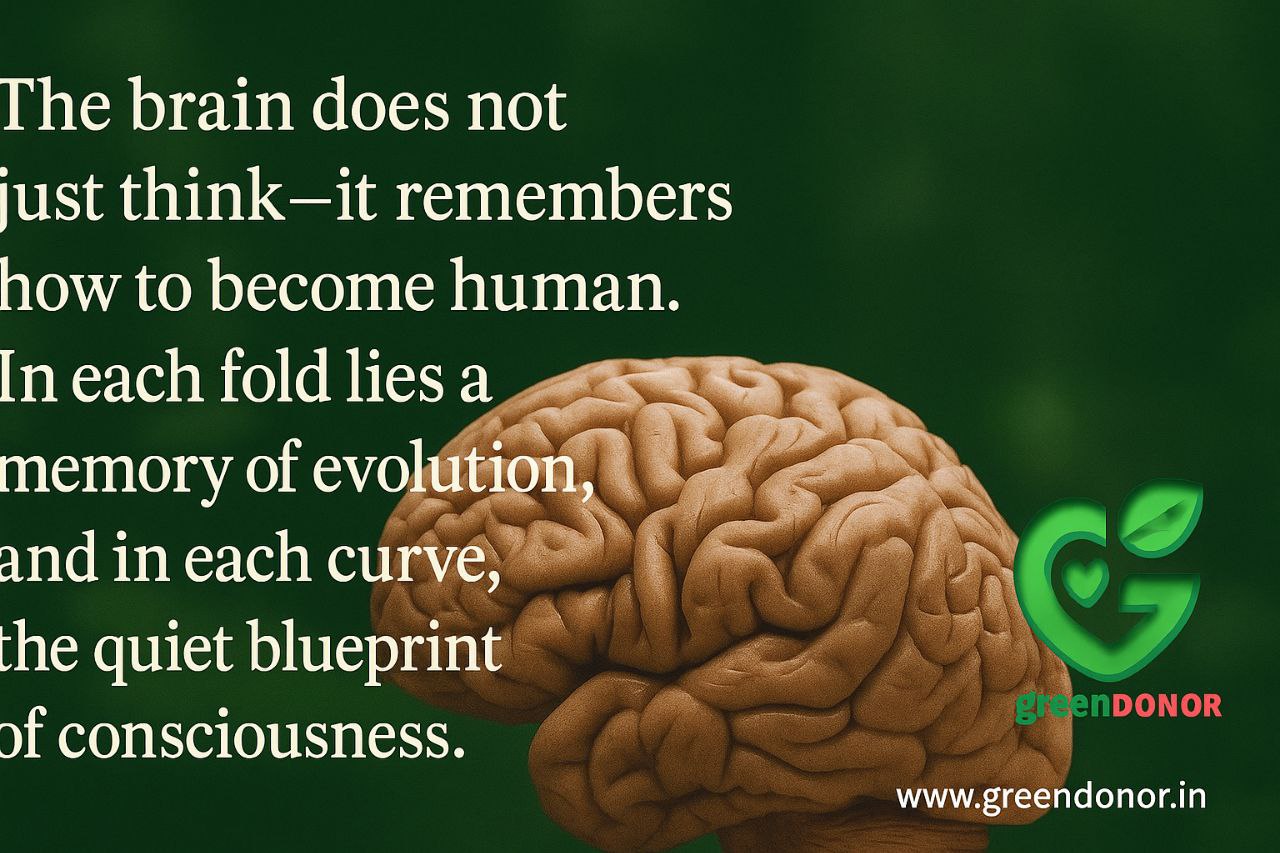
In a breakthrough that blends neuroscience with evolutionary insight, researchers have uncovered new evidence suggesting that the human brain’s folds—those ridges and valleys sculpted across its surface—are far more than just space-saving strategies. They may hold the secrets to how our species gained an edge in cognition, memory, and abstract thought.
A study published by neuroscientists from the Max Planck Institute and Radboud University reveals that these cortical folds in the human brain are not only more pronounced than in our primate relatives but also follow distinct developmental blueprints. The research compared MRI scans of 65 humans with those of 82 chimpanzees and macaques, focusing on both the depth and positioning of brain folds.
What they found was astonishing: the human brain doesn’t just have more folds, but its folds grow deeper and earlier during development, pointing toward a unique organizational structure that could be the key to our mental evolution.
🧠 More Than Surface-Level Complexity
While it’s known that brain folding (gyrification) allows for greater surface area in a compact skull, this study dives deeper—literally. The sulci (valleys) in the human brain aren’t just more numerous; they originate earlier in the prenatal phase and expand in ways not observed in nonhuman primates.
This means the foundation for our uniquely human cognition may be laid long before birth—etched into the very fabric of fetal development.
🧪 Why It Matters
The implications are profound. The study suggests that the shape and timing of brain folding are evolutionary adaptations that support higher-order functions—language, self-reflection, emotional nuance, and even moral reasoning.
In essence, the folds of our brain may be evolutionary fingerprints of consciousness itself.
🌍 Nature, Evolution, and the Human Story
This isn’t just science—it’s a meditation on what it means to be human. From a lump of cells to a mind that questions the stars, the journey is guided by invisible forces—like the deepening grooves in a developing brain.
And if those folds are indeed the physical scaffolding of thought, then understanding them brings us closer to understanding ourselves—not as separate from nature, but as its most complex reflection.
—
Veer’s Reflection:
In the folds of our brain lie echoes of evolution, whispers of ancestors who gazed up and wondered—just like us. Nature, it seems, folds not just matter, but meaning.
#BrainEvolution #HumanBrain #Neuroscience #BrainFolds #CognitiveScience #Humanity #EvolutionaryBiology #MindAndConsciousness #ScienceByVeer